


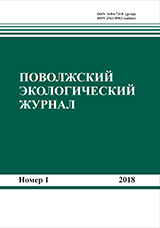
"Povolzhskiy Journal of Ecology" is a reviewed open-access scientific journal not charging authors for publishing papers.
The journal has been published since 2002, four issues per year. The volume of each issue is 10 printed sheets.
The registration certificate of mass media PI No. FS77-23682 issued on March 16, 2006 by the Federal Service for Supervision in the Sphere of Communications, Information Technologies and Mass Communications (Roskomnadzor).
The journal is distributed throughout the Russian Federation and in the CIS countries. Its subscription index is 39729: in the United catalog "Press of Russia", section "Nature. The world of animals and plants. Ecology". You can subscribe to the journal in any post office, as well as via the Internet (www.akc.ru).
The "Povolzhskiy Journal of Ecology" accepts papers, in Russian and English, presenting the results of scientific research in various areas of theoretical and applied ecology, including the ecology of ecosystems, communities, populations, environmental ecology and evolutionary ecology. Priority is given to research papers based on explicitly formulated hypotheses. The journal also publishes review articles on priority areas of ecology.
The journal is enlisted in
- into the Scopus (from 2021), Russian Science Citation Index on the Web of Science platform (RSCI), Zoological Record, EBSCO, Google Scholar
Current issue
For the first time, information on the taxonomic diversity, distribution features and categories of status of birch mice of the genus Sicista in the Volga region was summarized based on an analysis of our own and literary chromosomal and molecular data, a study of museum collections and regional Red Data Books. The important role of chromosomal and molecular markers in clarifying the taxonomic status of Sicista species and forms and their location in various districts of the Volga region has been confirmed. A gradient was identified in the biodiversity of the genus, represented by sibling species and forms of an unclear taxonomic rank Sicista of the betulina and subtilis groups, generally coinciding with the north-to-south change of the natural zones in the Volga region. Data on the status category of protected species and forms of mice were extracted from the Red Data Books of the Volga regions and the Appendices to them, and the role of protected areas in the Volga region in the preservation of rare species and forms of Sicista was partly shown.
The article presents the results of our morphological variation analysis in a few populations of Fritillaria ruthenica Wikstr., F. meleagris L., and F. meleagroides Patrin ex Schult. et Schult. fil., rare ephemeroids of the Liliaceae family. Three populations of F. meleagris , 14 populations of F. ruthenica , and 21 populations of F. meleagroides from the Vladimir, Samara, Penza, Tambov, Voronezh, Saratov, Volgograd, Rostov and Kursk regions, and the Republics of Kalmykia and Bashkortostan were studied in 2014 and 2023–2025. 12 morphological parameters from 30 plants of the generative state were measured in each population. All three Fritillaria species studied are characterized by a high level of intraand interpopulation morphological variability. The contribution of most of the studied morphological traits to variability was statistically significant ( p < 0.05). Plant height and diameter, lower leaf length, width, and thickness, and stem diameter are the most important factors responsible for the observed variation pattern of Fritillaria . As a result of assessing the relationship of the observed variation pattern with environmental variables, the most significant climatic factors were identified. The variation pattern of Fritillaria is virtually independent of altitude. For F. meleagris , a decreasing southwest-to-northeast trend in the parameters most responsible for morphological variation was found across its range. Furthermore, the number of temperature factors correlated with the observed variation pattern was significantly greater than that of humidity factors. In fact, humidity factors significantly influence the pattern of morphological traits variation during the driest period of the year only. For F. ruthenica , unlike F. meleagris , only humidity factors were found to be highly correlated with the variation pattern, and this correlation was moderate, rather than strong, as in F. meleagris . For F. meleagroides , the correlation between bioclimatic factors and the variation pattern was very weak. This is likely due to the fact that, unlike the two previous species, F. meleagroides is a representative of intrazonal vegetation, occupying habitats with high humidity (floodplain meadows) within essentially the same range as F. ruthenica , which grows in steppe areas in regions with the continental climate.
Data on the abundance, biomass, and species composition of planktonic crustaceans, rotifers, and ciliates, as well as the abundance of microorganisms such as bacteria, heterotrophic nanoflagellates, testate amoebae, and phytoplankton pigments were obtained during a three-month study of a small water reservoir where a predatory plant Utricularia vulgaris L. was the dominant species in the phytocenosis. The concentrations of chlorophyll a and the number of bacteria indicated the eutrophic status of the pond. Copepoda (Cyclopoida and Calanoida) accounted for the majority of zooplankton abundance and biomass. Cladocera were represented by two small-sized species Bosmina longirostris (O. F. Müller) and Chydorus sphaericus (O. F. Müller). The highest abundance of rotifers, ciliates, and testate amoebae was observed in early summer. The Utricularia traps studied contained 2–4 organisms. A total of 26 different species and other taxa were identified among the victims. Larvae of Chironomidae, as well as copepodites and adult copepods, were the most common prey items. The number of C. sphaericus in the traps increased during the season. At the same time, the number of C. sphaericus in the plankton population was low. Throughout the entire period of active vegetation, predatory feeding of Utricularia vulgaris was observed, despite some evidence of a high trophic status of the environment and the assumed availability of nutrients for autotrophic nutrition.
Peculiarities of the hydrochemical conditions in the Ivankovskoye, Shushpanskoye, Chelnavskoye, Matyrskoye, Starooskolskoye, Belgorodskoye reservoirs and the biological status of common roach according to our data collected from May to October, 2010–2022, are shown. The study notes that short-term excesses of the limit concentrations of the regulatory values (O2, pH, nitrates, ammonia, total iron and phosphates) are not critical for roach growth. E.g., the organic pollution (BOD5) characteristic in the Belgorod reservoir exceeded the norm 4 times. The optimum situation for roach life activity was observed in the Shushpanskoye reservoir, where males reach the largest size of 25.1±0.6 cm and 224.0±17.1 g, females 23.6±0.6 cm and 226.8±11.6 g, respectively. Common roach is able to tolerate short-term excesses of BOD5, so roach growth was similar to the average in almost all limnic reservoirs when BOD5 changed from 1.5±0.2 to 3.4±0.7 mgO2/dm3 . Exceeding BOD5 by a factor of 4 inhibited the size and weight growth of males and females by a factor of 1.4 on average.
Studies over the last decades have shown that microplastic pollution along with other factors of the anthropogenic impact may have a negative effect on the biological productivity of water bodies, including fluctuations in the numbers and biomass of commercial populations. Due to this ecological problem’s relevance, microplastics were first time surveyed on the Lake Ilmen in May, 2024. The study was carried out throughout the lake, and surface water sampling was made for microplastic particles content using a Manta trawl (335 μm). Analysis of pollutants at 15 stations revealed the presence of synthetic polymer particles, organicand inorganic components, as wel as semi-synthetic fibers in the water samples. This is indicative of the lake micro-scaled pollution, as the found contaminants, including fibers, may pose a potential threat both to single species of aquatic bioresources living in the reservoir and to its ecosystem as a whole. Our quantitative assessment of the concentrations of microplastics and particles of various nature in the Lake Ilmen waters indicates negligible microplastic pollution, not exceeding 0.02 pcs/m3 . These results can be used as a background (baseline) level for further studies of environmental risk from exposure to microplastics in the Great Lakes of northwestern Russia, which are of commercial fishery importance, as well as in other reservoirs of the Novgorod region.
The paper provides a comparative analysis of mercury (Hg) accumulation in the muscle tissue and organs of commercial fish in the Gor’ky and Cheboksary reservoirs. The research material consisted of 120 specimens of four fish species, namely: Blicca bjoerkna , Abramis brama , Rutilus rutilus , and Perca fluviatilis . The mercury concentrations in the muscles, liver, gills, and gonads were analyzed for each species group. The results showed a pronounced species specificity of accumulation, namely: the highest Hg concentrations were recorded in the muscle tissue and liver, the lowest it in the gills and gonads. Predatory perch is characterized by a higher mercury level, which reflects the influence of its trophic position. Correlation and covariance analysis revealed a significant dependence of mercury concentration in muscles on body length in most fish species, whereas this dependence was less pronounced and variable for the liver, gills, and gonads. The data obtained confirm the informative value of muscle tissue as an indicator of long-term mercury pollution and emphasize the need to take into account the species composition and size-age structure in the environmental monitoring of reservoirs.
Features of the specific, spatial and trophic structure of macrobenthos communities in a lagoon ecosystem located at the outlet of the inner area of the Kislaya Bay (Kandalaksha Gulf, White Sea) were studied. 35 species of benthic invertebrates, as well as 9 ones of seagrasses and algae, were found in the lagoon. In it, there is a well–marked vertical gradient in the macrobenthos community structure (from the upper littoral to the middle, lower, and sublittoral) and a less pronounced longitudinal one, from more silty and desalinated coastal habitats to marine ones. Our statistical analysis made it possible to identify a sublittoral macrobenthos (dominated by Macoma balthica mollusks and polychaetes Terebellides stroemi, Nereimyra punctatata, Pontoporeia femorata, Scoloplos armiger, Phyllodoce maculata ), a community of macrobenthos of the lower and middle littoral, dominated by Macoma balthica, Mya arenaria (more in the middle littoral), Arenicola marina, Littorina littorea and Mytilus edulis (more in the lower littoral) and the macrobenthos community of the upper littoral, together with the inner district middle littoral, dominated by small eurytopic species Peringia ulvae, Tubificoides benedii and Littorina saxatilis . In the lagoon, due to its shallow waters, isolation from the sea, predominance of silt-sand sediments and some freshening, mainly detritiphages predominate; their percentage decreases in the middle and lower littoral and increases towards the sublittoral and upper littoral.

ISSN 2541-8963 (Online)


